Reading the game · Anywhere
Flat track and banked track: two different sports
Same skates, same oval, very different games. How the flat floor took over the world, why the banked track still has devoted cities, and what changes from your seat.
flat and bankedMost of the year
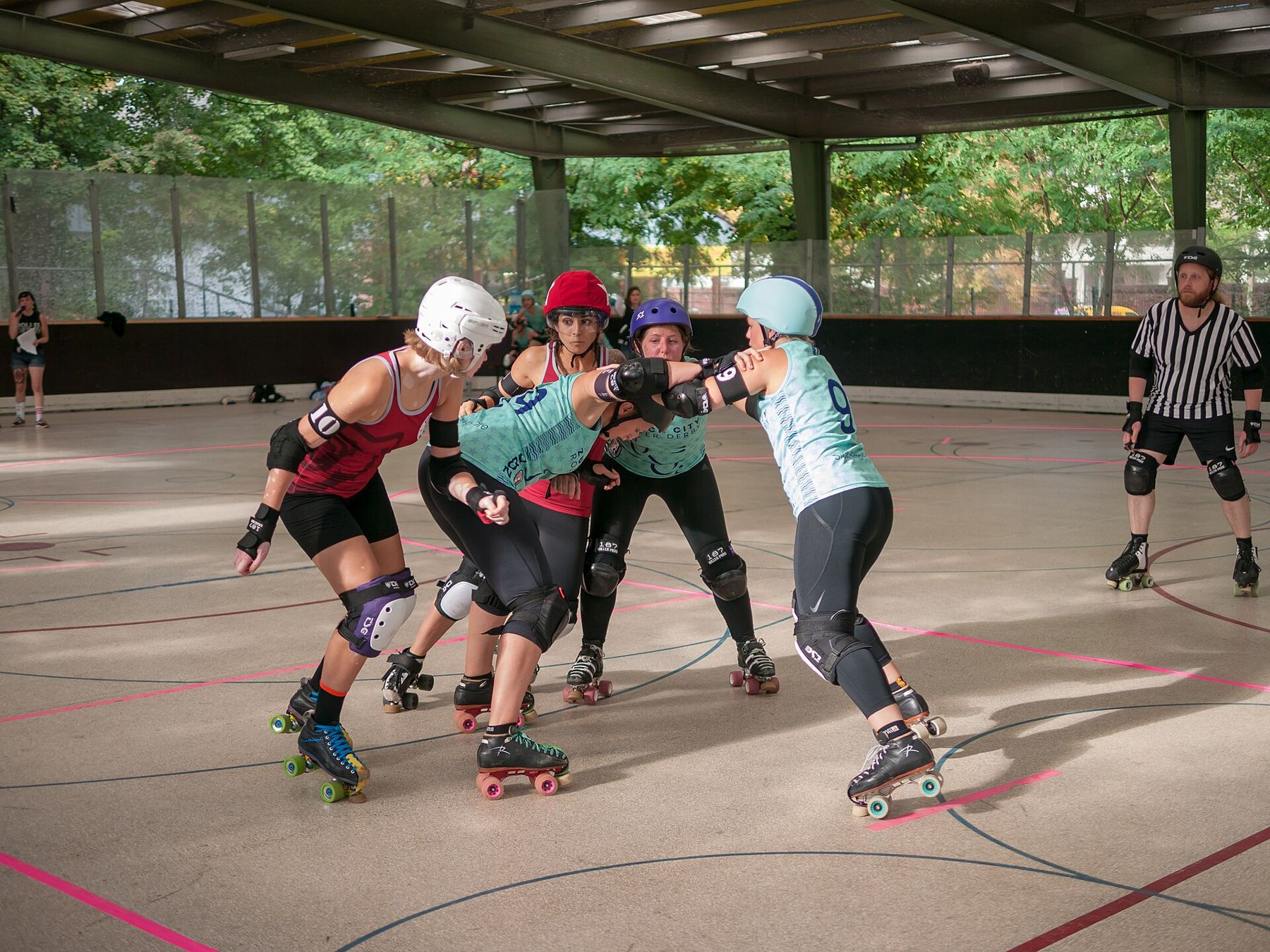
Roller derby is played on two kinds of track, and fans who switch between them often say it feels like watching two related sports rather than one. The flat track is a taped or roped oval on an ordinary floor. The banked track is a raised wooden oval with sloped curves and a rail around the edge. Almost every league in the world now plays on the flat, but the banked track never went away, and a trip to see it is worth planning if you love the game.
Where the banked track came from
The banked track is the original. When the sport began as an endurance race in 1935, skaters circled a sloped track for days on end, and the contact game that grew out of it kept the banked oval through the decades of television and touring that followed. The story of that era is told in the pieces on the 1935 Transcontinental Roller Derby and the later television and banked-track years.
A banked track is expensive. It has to be built, stored, moved and maintained, and it needs a venue with enough floor space and ceiling height to hold it. When the professional game collapsed in the 1970s, the tracks mostly went with it.
Why the revival went flat
When skaters in Austin rebuilt the sport in the early 2000s, some leagues kept the banked track, but the flat track quickly became the default for one simple reason: anyone could set one up. A flat track needs a smooth floor, a measured layout and something to mark the boundary. A sports hall, a roller rink, a warehouse or a covered outdoor court will do. That made it possible for a new league in a mid-sized city to start with almost no money and a borrowed floor.
The flat-track game also became standardised. The Women's Flat Track Derby Association published shared rules and track dimensions, so a league in one country could play a league in another without arguing over the basics. That shared rulebook is a large part of why the sport spread so far, so fast. You can read more in how the WFTDA grew.
What changes on the track
The basic structure is familiar on both surfaces: jams, jammers trying to lap the pack, blockers trying to stop them. The physics are what differ. On a banked track, skaters can carry far more speed through the curves, because the slope holds them in. Jams look faster and longer strides are common. Hits tend to push opponents up the bank or into the rail rather than out across a painted line.
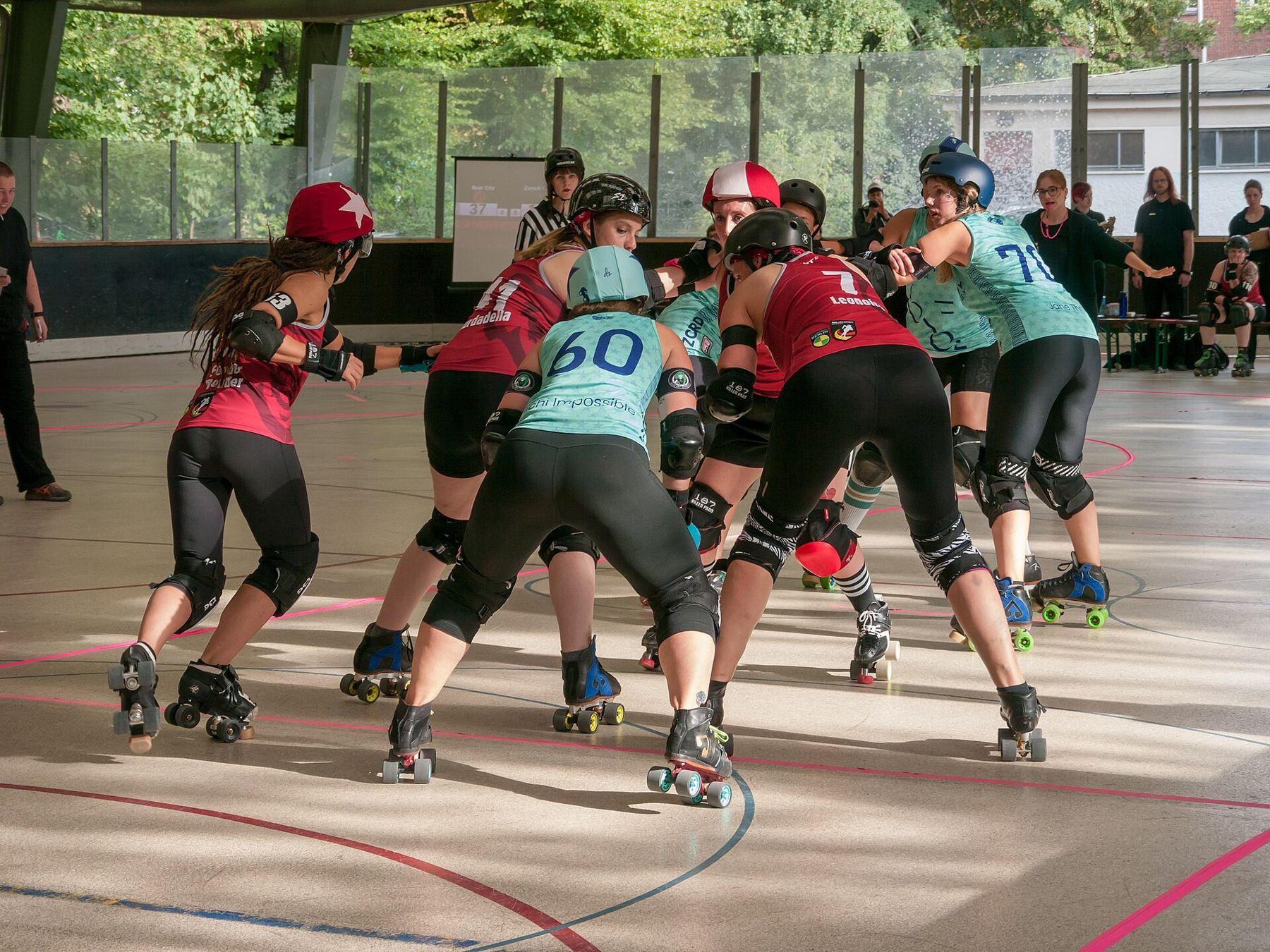
On a flat track, every curve is a fight against momentum. Skaters have to lean, step and brace to stay inside the boundary, and the game rewards footwork, low stances and tight walls of blockers. Much of the strategy lives in slow, grinding play, with packs crawling while the jammer looks for a gap. If you are new, the guide to how a game works covers the current flat-track structure in general terms. Rules on both surfaces are revised from time to time, so the small details shift between seasons.
Between jamsLos Angeles and the banked trackWhat changes for you in the stands
For spectators, the biggest difference is where you sit. At many flat-track games, fans sit on the floor or on low benches close to the boundary. Leagues mark a safety zone between the track and the crowd, and some keep the closest seats for adults only. Being that close is part of the appeal: you hear the hits and see skaters fly past at knee height.
At a banked game, the track itself lifts the action up. A rail separates skaters from the crowd, and the best view is often from raised seating, looking down into the curves. The sound is different too. Wheels on a wooden track make a deep rumble that builds as the pack comes around, and the noise in a full venue can be loud enough that earplugs are a good idea.
Flat-track games are also far easier to find. On almost any weekend in season, there is a flat-track game somewhere within reach of a big city. Banked games are rarer and tend to be concentrated in a few places, so they reward a little planning.
Where banked derby survives
Banked derby lives on in a small number of cities, mostly in the United States. Austin and Los Angeles are the names most fans mention, and both are worth a trip for anyone who wants to see the two versions side by side. The guide to a derby weekend in Austin covers a city where you may be able to see both kinds of game, depending on the schedule.
Banked leagues often run their own seasons and formats, and they do not all follow the same rules. Venues also change, because finding a building that can house a permanent banked track is hard.
Which one to see first
If you are new to the sport, start with a flat-track game. It is what most of the world plays, it is easy to find, and the rules you learn will apply almost everywhere. Once the pack and the jammer make sense to you, a banked game becomes a revelation: the same ideas, played at a different speed, in a building that hums with the noise of the track.
Skaters who have played only flat track sometimes get the chance to try a banked track at open sessions or training camps. If that interests you, ask the league well in advance, bring your full protective gear, and expect to be taught how to fall and recover on the slope before you skate at speed.
Seen together, the two tracks tell the whole history of the sport: the banked oval of the early races and the television era, and the flat floor that let a skater-run revival reach small cities around the world.